
Certified green ammonia

Neptun develops green ammonia produced from renewable energy in Northern Norway. By combining green hydrogen with nitrogen from the air, we aim to deliver certified ammonia with a very low carbon footprint.

Green ammonia

From renewable energy to green ammonia

Our ammonia is produced by combining nitrogen captured from the air with green hydrogen produced through electrolysis.

The electricity used in both hydrogen and ammonia production is supplied by regional hydro and wind power, providing reliable, renewable and clean energy.
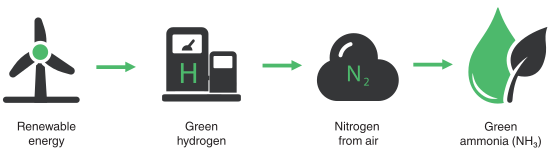
ikoner-renewable-energy-

EU RFNBO-compliant

The renewable attribute travels with the physical ammonia on a mass-balance basis.

AEA certified

Certified low-carbon ammonia with transferable registry certificates.

ISCC+

ISCC+ certification can also be provided if requested by the offtaker.

Certified production

A documented low carbon fotprint

Neptun's production is designed to deliver certified ammonia with a cradle-to-gate carbon footprint of:

≤0.01 tCO₂e / t NH₃

RFNBO compliance

Meeting the requirements for renewable fuels

Neptun's projects are designed to meet the requirements for classification as a Renewable Fuel of Non-Biological Origin (RFNBO).

01

Renewable electricity

Power is drawn from Norway's NO4 bidding zone, which is approximately 98% renewable. Guarantees of origin are cancelled for every MWh used in certified production.

02

GHG saving threshold

The RFNBO threshold requires a 70% greenhouse gas saving compared with the fossil comparator. Neptun's certified footprint is ≤0.01 tCO₂e/t NH₃.

03

Third-party certification

Pre-certification is underway with CertifHy, an EC-recognised voluntary scheme. Product carbon footprint certification under AEA is being developed in parallel.

LIFECYCLE EMISSIONS

A significantly lower carbon footprint

The combination of renewable electricity, hydrogen produced from water and nitrogen captured from air enables very low lifecycle emissions.

<0.1

gCO₂e/MJ

Expected Neptun lifecycle emissions

28.2

gCO₂e/MJ

RFNBO threshold

94

gCO₂e/MJ

Fossil comparator

Extending the calculation

Extending the calculation to end use shows expected reductions of 81–98% across the illustrative cases.